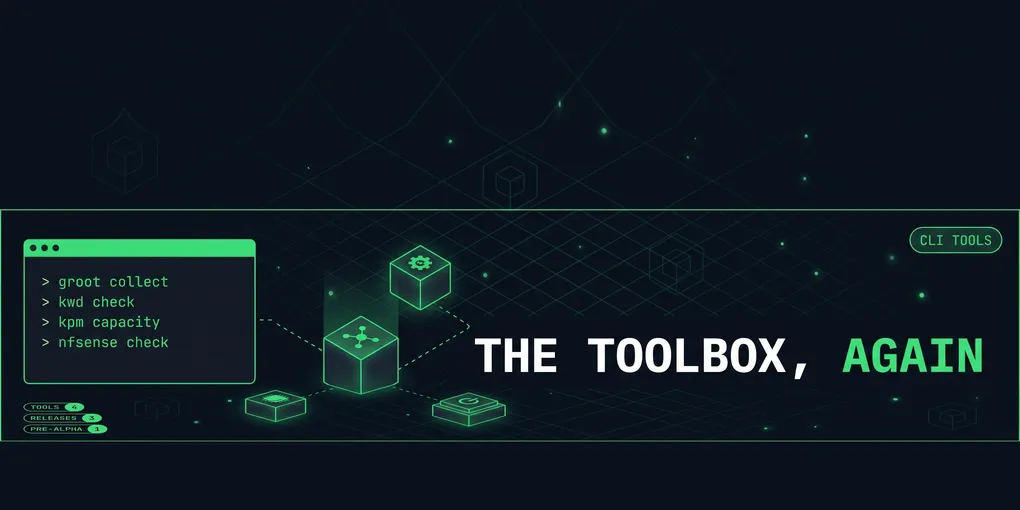
The toolbox, again — what I've been building since the GROOT 1.0 note
I have not written on this site since the pgwd on awesome-go note in September. That is roughly seven weeks of shipping and almost no writing, which is the wrong ratio for a site whose whole premise is “when something ugly finally makes sense, I like to write it down.”
So here is the catch-up. Not a deep dive into any single thing — a map of where the work went, what is stable, what is still cooking, and the one thread that ran through all of it.
The thread: one advisory, three binaries
MPTCP is on by default in Linux since 5.6, and Go has enabled it on new listeners since 1.24. That combination turns out to matter, because CVE-2026-98432 is a use-after-free in the IPv4 TCP options path — CVSS 9.8. It is not an MPTCP-only bug; plain TCP reaches the same race. But an MPTCP listener is a listener that was never asked for.
Rather than patch one tool and hope, I swept the family:
| Repo | Change | Merged |
|---|---|---|
| groot-trigger | SetMultipathTCP(false) on the trigger listener |
2026-11-07 |
| kwd | Same, on the daemon HTTP listen | 2026-11-07 |
| groot-share | Same, on the public gfs listener |
2026-11-08 |
Each one is the same three layers: net.ListenConfig.SetMultipathTCP(false) in the code, godebug multipathtcp=0 in go.mod, and GODEBUG=multipathtcp=0 in the Deployment. The third layer is the one people forget, and it is the one that covers the case where the binary is rebuilt by someone else.
Two things worth being explicit about:
The code fix does not close the CVE. The real fix is a kernel patch — 5.10.272, 5.15.223, 6.1.190, 6.6.159, 6.12.113, 6.18.56, 7.2.10, 7.3. If you run an unpatched kernel, none of the above helps you. The binaries are hardened against the MPTCP-specific exposure; the UAF itself is still yours to patch.
Binding to 127.0.0.1 does not disable MPTCP. That was my first instinct and it was wrong. If you want it off, you have to say so.
Also worth knowing, because it cost me an afternoon: ListenConfig.SetMultipathTCP(false) wins over GODEBUG=multipathtcp=1. The GODEBUG default only applies when the code does not set the value explicitly.
GROOT 1.2 and 1.3
GROOT is at v1.3.1 as of this morning. Since the 1.0 note it has gained Slack rich notifications, a client-id in the notify manifest, and a steady diet of dependency bumps — k8s.io/client-go and k8s.io/metrics to 0.37.2, klauspost/compress to 1.18.7, and the toolchain to Go 1.27.3.
The 1.0 note said the config and archive contracts were frozen. They still are. The versions since have been additive: notifications got richer, the dependency floor moved, and the security note in SECURITY.md now points operators at the host-kernel caveat instead of pretending a CLI can fix a kernel bug.
The family grew too, which is the part I did not plan:
- groot-trigger — v0.2.1. The in-cluster trigger that ships archives out.
- groot-share — v0.8.1. The share side, and the one that was public on a VPS, which is why its MPTCP patch was the most urgent of the three.
- groot-selfhosted — v0.2.17. Manifests only. No binary.
That last one is the pattern I want to keep: the product repo and the operator repo stay separate. The product ships code and packages; the operator repo ships manifests and the operational notes. It keeps the blast radius of a compromised install script away from the thing people actually run in production.
kwd — a new one
kwd is new, and it is at v0.4.1 (pre-1.0, so the config schema and exit semantics can still move).
The problem it solves is embarrassingly common: a rollout finishes, and someone has to go look. Is the Deployment actually ready? Did the StatefulSet come up, or is a pod crash-looping? Most “health checks” are either ad-hoc kubectl get squinting at columns, or a full Prometheus/Grafana stack you do not want to stand up just to answer “is it up?”
kwd is a single binary that uses client-go directly — no kubectl subprocess — and answers that question two ways:
interval: 0→ a single pass, exit0or1. Meant for cron and CI.interval > 0→ a daemon loop: same check path, notify on transitions, optional/healthzand Prometheus/metrics.
Declarative, out-of-band, scriptable. The point is not to replace a monitoring stack; it is to not need one for the “is this thing up right now” question. In 0.4 it gained forced notifications, a notify test mode, and Slack attachments with health-check fields.
kwd-selfhosted follows the same product/operator split as everything else.
kpm reached 1.0
kpm shipped v1.0.0 on 18 October and is now at v1.1.1. If you have not read the dev.to piece, that is the one to read — it covers the idea better than I will here.
Short version: kpm samples pod CPU and memory into local SQLite and computes rightsizing recommendations from historical p95 against requests and limits. No Prometheus required, and the history lives on your laptop rather than in someone else’s cluster.
Two things from 1.0 and 1.1 that I care about more than the feature list:
trusted_proxies fails closed. An entry that does not parse refuses to start. This is the behavior I want from every config parser in every tool I maintain: a typo in the trust list should stop the binary, not silently widen who is allowed to spoof the client address.
It prints what it does not model. kpm capacity fit answers “does this workload land here” — cordon, taints and tolerations, nodeSelector, required affinity, requests — and then explicitly lists the things it is not accounting for: affinity spread, topology constraints, volume zone binding, fragmentation. A number without that caveat reads as authoritative, and an authoritative wrong number is worse than no number.
1.1 added GET /livez (with /healthz kept as an alias so existing probes keep working), Go 1.27.3, and golang.org/x/net to v0.62.0.
nfsense — pre-alpha, and honest about it
nfsense is the newest thing, and the least finished. It is a Debian firewall manager built on nftables, and right now it can do exactly one thing: keep a draft document in SQLite.
I want to be blunt about the state, because the README says it and I agree with it: there is no nftables code in this repository yet. The binary cannot read, check, or change your firewall. The only committed work is the intended-state draft store with compare-and-swap — because the store has to come before anything that talks to the kernel.
The intended shape is draft → check → apply → confirm → rollback, with a timed confirm and a soft rollback so a bad change gives you back the box. The design constraint I care about most: nfsense owns its own tables and never runs nft flush ruleset over tables it did not create. Other tools’ rules are not its business.
There is a comparison against firewall4, foomuuri, csf-firewall and iptables-apply that spends most of its length on where nfsense is weaker — starting with the fact that zones are not in v1 and that compile-and-apply is table stakes, not a differentiator. If you are going to look at it, look at that document first.
gghstats, and a floor that stuck
gghstats went out v1.6.8 in October after a security review, and the more interesting part was what the review changed about how I manage dependencies.
The floor on golang.org/x/net is now expressed as a replace directive in go.mod, not a require:
replace golang.org/x/net => golang.org/x/net v0.60.0This looks like a detail and is not. A require does not survive go mod tidy — tidy removes it, because no package of x/net is imported directly — and a go get fights it on every lint run. The replace survives, and it pins the version effectively even though x/net still arrives in the graph through client_golang’s common package. Without it, a future dependency could drop us back to a vulnerable version without anyone noticing.
The deeper lesson, which cost me the review to learn: the mitigation that actually mattered was the toolchain, not the pin. The stdlib advisories in question are fixed in Go 1.26.9 and 1.27.2. We are on 1.27.3, which gives real margin. The pin is defense in depth; the toolchain is the fix.
The other half was admitting what I could not fix. govulncheck is the gate, and the one that matters, because the advisory database is live and a scan that silently scans nothing is worse than no scan.
And this site
The site itself moved to Astro 7.4.7 this week, which came with a raised Node floor (22.23.4) and a sharp advisory that needed 0.35.x — the same line Astro 7.4 expects anyway. Build output, RSS, sitemap and structured data all verified unchanged.
Worth noting for anyone who builds static sites on a schedule: the lockfile for this site is regenerated on linux/amd64, not on the machine I type on. An Apple Silicon laptop will happily produce a lockfile that differs from the one CI uses. The Makefile has a target for this that runs the install inside a node:22-alpine container with the right platform flag. Use it.
What is stable, and what is not
To be explicit, since “new release” is not the same as “ready”:
| Tool | Version | Maturity |
|---|---|---|
| groot | v1.3.1 | Stable — contracts frozen since 1.0 |
| kzero | v1.1.4 | Stable |
| kpm | v1.1.1 | Stable — 1.0 contract frozen |
| kwd | v0.4.1 | Pre-1.0 — schema and exit semantics may change |
| gghstats | v1.6.8 | Stable |
| nfsense | none | Pre-alpha — no nftables code yet |
| gghstats-xui | v0.1.3 | Pre-1.0 — alternative UI, SvelteKit BFF in front of gghstats |
Every one of the released Go tools ships as a single binary with .deb/.rpm, a container image, Cosign signatures and an SBOM, and the install path is meant to stay a single curl … | sh line you can read before you run it. All of them are on Go 1.27.3 except nfsense, which is on 1.26 while it is still pre-alpha.
gghstats-xui deserves one line: it is an alternative SvelteKit front-end with the token kept server-side, so it is a different way to use gghstats, not a replacement for it. The theme it ships with is deliberately not the one I like best for myself — it exists so other people can adopt the shape without inheriting my taste.
Where it goes next
The short list, in the order I intend to attack it:
- Patch the kernels. Everything above is mitigation, not remediation. The family is hardened; the hosts still need
apt upgrade. - Finish the rest of the gghstats audit. The P0s are closed and 1.6.8 is out. The remaining block — XFF handling, cosign-verified install, Actions pinned by SHA, SMTP hardening — is still open.
- Give nfsense a kernel. The draft store works. The check/apply/confirm pipeline does not exist yet.
- Keep writing. This post is a map, not a manual. The individual tools deserve their own notes when there is something worth saying.
If you want to follow along, RSS is the quietest way, or the blog index if you like the noise.